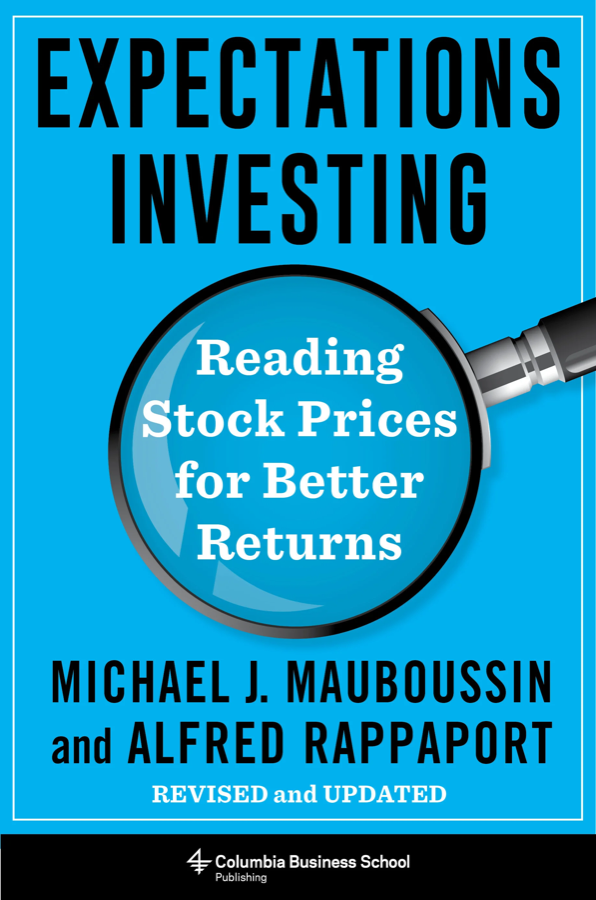
Expectations
Investing
Reading Stock Prices for Better Returns
Read the Price,
Then Anticipate the Revision
Expectations Investing offers a unique and powerful alternative for identifying gaps between stock price and value. Mauboussin and Rappaport provide everything the reader needs to utilize the discounted cash flow model successfully.
And they add an important twist: they suggest that rather than forecasting cash flows, investors should begin by estimating the expectations embedded in a company's stock price. An investor who has a fix on the market's expectations can then assess the likelihood of expectations revisions.
To help investors anticipate such revisions, Mauboussin and Rappaport apply an “expectations infrastructure” framework to trace the process of value creation from the basic economic forces that shape a company's performance—sales, costs, and investments—to the resulting impact on value drivers.
Investors who use Expectations Investing will have a fundamentally better way to evaluate all stocks, setting them on the path to success. Managers will be able to use the book to devise, adjust, and communicate their company's strategy in light of shareholder expectations.
The revised and updated version reflects recent changes in accounting and the business landscape and provides new case studies and examples.
Three Steps
Estimate Price-Implied Expectations
“Read” the expectations for cash flow embedded in a company's current stock price—using the market's own pricing model.
The approach → Step 2Identify Expectations Opportunities
Assess those expectations with competitive strategy analysis and consider the likelihood of upward or downward revisions.
The ten rules → Step 3Buy, Sell, or Hold?
Make the decision with a clear-cut after-tax margin of safety between the stock's price today and the expected price tomorrow.
Learn more →In Expectations Investing, Michael Mauboussin and Al Rappaport break down investing into its component parts, explaining what makes for good companies and attractively-priced stocks. Which isn’t to say they make it easy. This is second-level thinking: a graduate-level course in intelligent investing. Howard Marks — Chairman and Cofounder, Oaktree Capital Management
Everything You Need to Apply It
Chapter Summaries & Extras
What's new in the revised edition, chapter by chapter—plus three bonus chapters available only on this site.
Explore the book → FreeTen Online Tutorials
Step-by-step tutorials with downloadable spreadsheets: present value, value drivers, PIE analysis, M&A, and real options.
Start learning → The AuthorsMauboussin & Rappaport
About the authors, their other books, and their papers and articles on shareholder value.
Meet the authors →